
By Devcipator | No-Code & Low-Code Agency | June 2026
Scott Belsky is not a name you forget easily.
He built Behance, the platform that became the global home for creative professionals to showcase their work. He served as Chief Product Officer at Adobe. He has backed some of the most recognisable companies in tech, including Pinterest, Uber, Warby Parker, and Airtable.
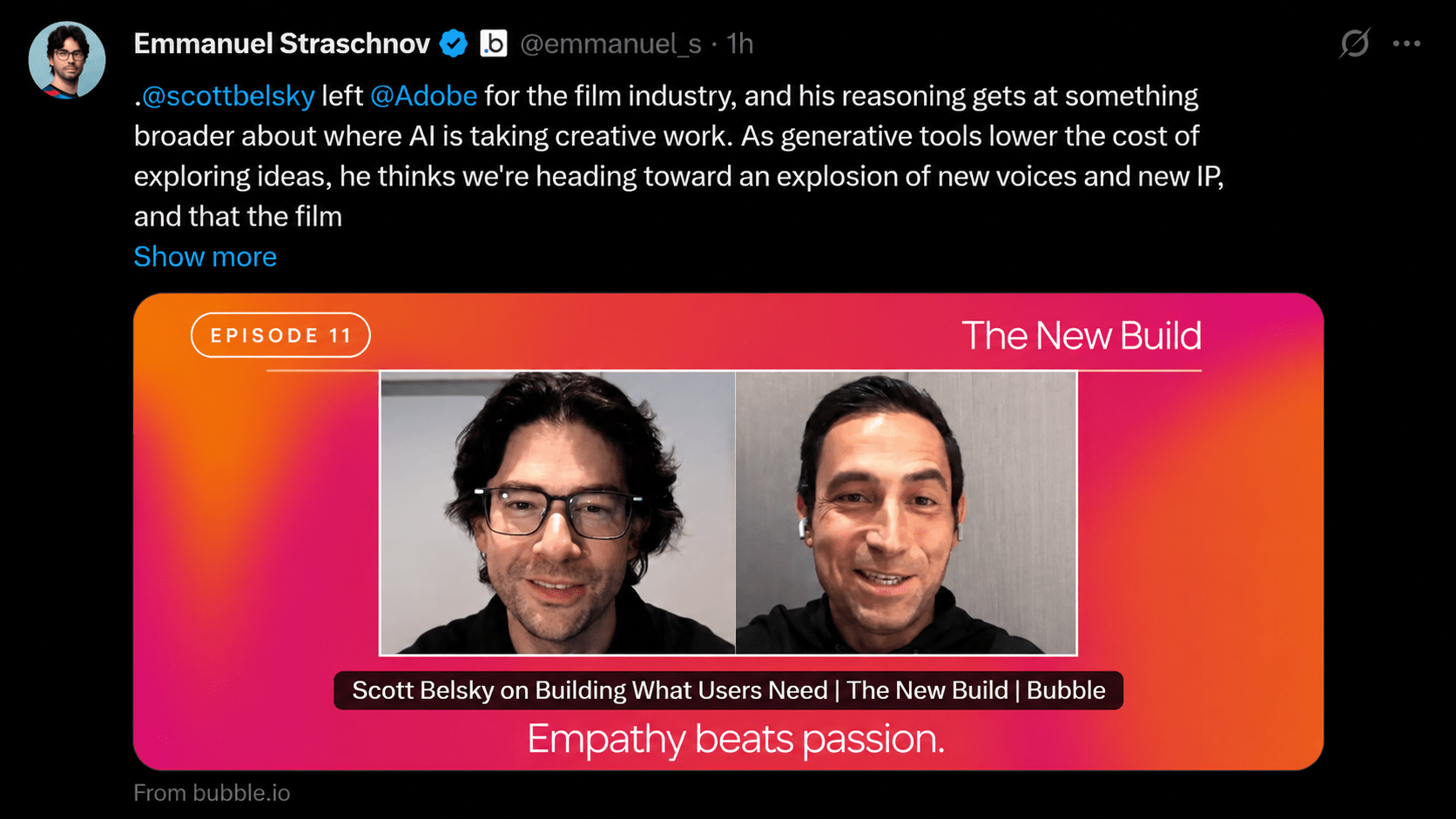
And in Episode 11 of Bubble’s “The New Build” podcast, he sat down to share what decades of building, investing, and shipping products has actually taught him.
The insights are worth slowing down for.
Build With Empathy, Not Assumptions
The single biggest mistake Belsky sees founders make is building what they think users want rather than what users actually need.
It sounds obvious. But it is the error that kills more products than any technical failure ever could.
Founders fall in love with their solution before they have truly understood the problem. They move fast, ship quickly, and then wonder why users are not sticking around. The answer is almost always the same: the product was built for an imagined user, not a real one.
Building with empathy means staying uncomfortable. It means talking to users when you would rather be building. It means letting what you hear change what you ship, even when that is inconvenient.
This is not a one-time exercise at the start of a project. It is a discipline that has to run through every stage of the product lifecycle.
Surviving the Messy Middle
Belsky has written and spoken extensively about what he calls “the messy middle,” and it came up again here for a reason. It is the most honest description of what building something real actually feels like.
The early days of a new product are energising. There is momentum, novelty, and the thrill of something new coming to life. Then that phase ends.
What follows is a long stretch where the excitement has worn off, the hard problems have surfaced, and success is still nowhere in sight. The feedback is mixed. Progress is slow. Doubt creeps in.
This is where most founders quit.
The ones who do not quit are rarely the ones with the best product at that moment. They are the ones who have decided that staying in motion matters more than feeling certain. They keep learning, keep adjusting, and keep shipping. And because they do, they eventually reach the other side.
There is no shortcut through the messy middle. But knowing it is coming makes it survivable.
Investors Back the Founder, Not Just the Idea
When Belsky evaluates whether to back a founder, the product is not the primary thing he is looking at.
He is watching how the founder handles pressure. How they respond to feedback they did not want to hear. How they make decisions when the path forward is unclear. How they treat the people around them when things are not going well.
The idea will change. The market will shift. The original plan will almost certainly be wrong in ways neither party can predict.
What stays constant is the founder. And so that is what a serious investor is really betting on.
For anyone preparing to raise money or seek backing, this is the most important reframe: your pitch is not just about your product. It is a demonstration of how you think, how you learn, and how you lead.
What This Means If You Are Building Right Now
Belsky’s perspective is shaped by years at the highest levels of product and investment. But the lessons translate directly to founders at every stage, including the ones just getting started.
Build close to your users. Do not wait until you have the perfect product to talk to them. Talk to them now, before you have built anything, and let what you learn shape what you build.
Expect the messy middle and plan for it. Build with tools and partners that let you move fast and adjust quickly, because you will need to adjust. The founders who survive are the ones who can iterate without rebuilding from scratch every time.
Pick the right people to build with. Whether that is a co-founder, an agency, or a development partner, the relationship matters as much as the output.
How We Build at Devcipator
At Devcipator, every project we take on reflects these principles.
We build mobile apps, web apps, SaaS products, and MVPs using battle-tested no-code and low-code platforms. That means our clients can launch fast, stay close to their users, and update their product based on real feedback without waiting months for a development cycle to complete.
We have seen what happens when founders get this right: quick launches, real user data, rapid iteration, and products that actually grow. And we have seen what happens when they get it wrong: over-engineered products built on assumptions that never get tested until it is too late.
Belsky’s framework is not complicated. Build with empathy. Survive the messy middle. Find people who believe in you, not just your current idea.
That is the playbook. We help you execute it.
The Takeaway
Scott Belsky has been around long enough to see what separates the products that make it from the ones that do not. It is rarely about technology. It is almost always about discipline, empathy, and the ability to keep going when things get hard.
The tools available to founders today make the execution side easier than it has ever been. No-code platforms mean you can build and ship faster than any previous generation of founders. But the human side of building, staying close to users, surviving uncertainty, finding the right partners, that has not changed.
If you are building something right now, or thinking about it, this is the moment to move. You do not need to wait until everything is perfect. You need to start, stay close to your users, and build with people who understand what that actually takes