
By Devcipator | No-Code & Low-Code Agency | June 2026
Major tech publications have been running headlines declaring no-code finished, pointing to AI-generated “vibe coding” as the killer. The New Stack ran the headline “No Code Is Dead.” Inc Magazine published “Was Vibe Coding a Ruse?” DEVOPSdigest gave a platform to senior voices who both claimed, in different language, that no-code is finished.
If you work in or around the no-code space, you’ve probably had someone forward you one of these pieces with a knowing look. And if you’ve been considering building your next product on a no-code platform, you might be second-guessing yourself.
Here’s the thing: they’ve got the diagnosis right and the patient wrong.
What Are They Actually Attacking?
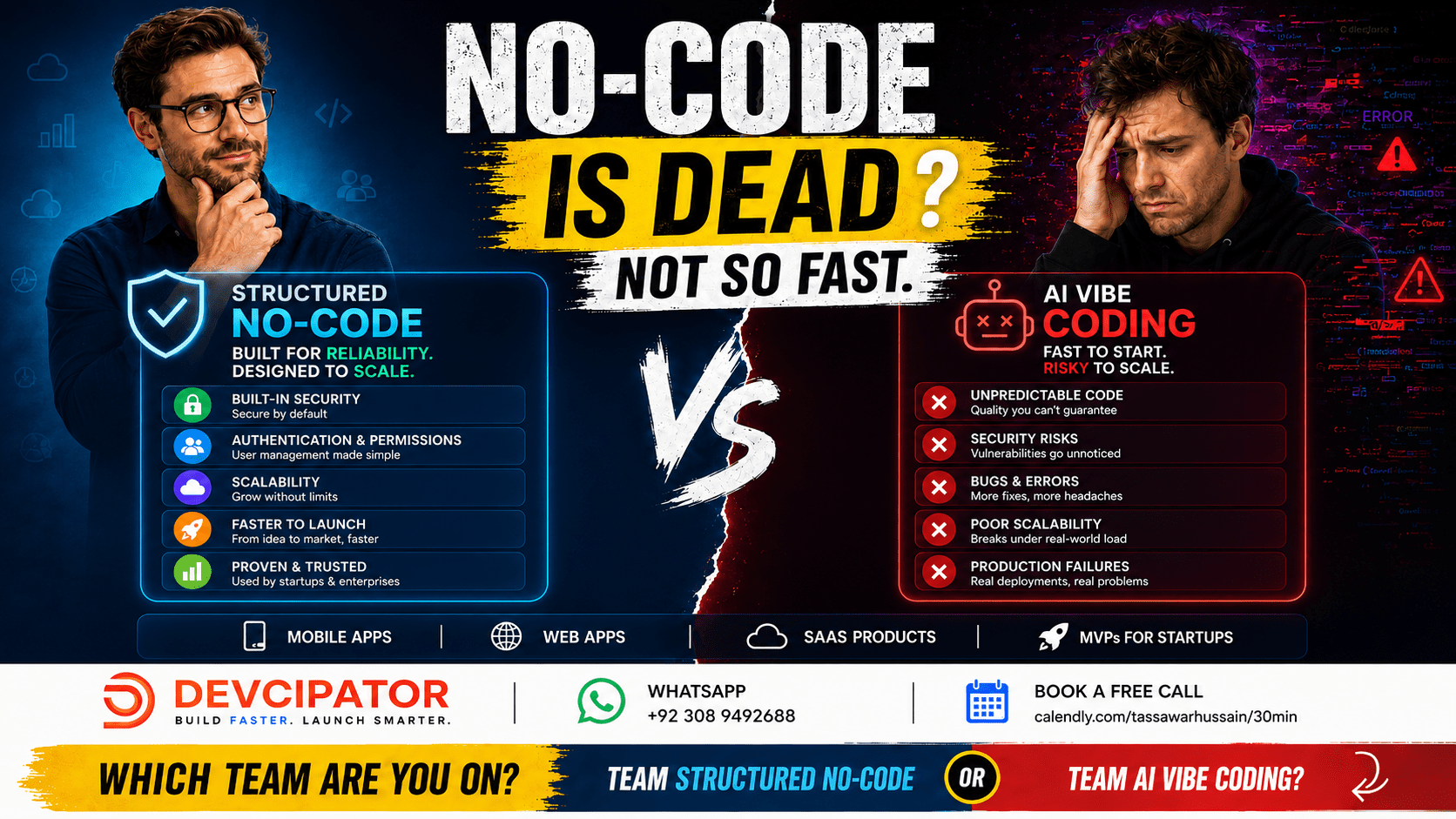
Every one of these pieces makes the same category error: they use “no-code” to mean “AI-generated code with no scaffolding.” But that’s not what no-code is. That’s vibe coding.
Vibe coding is a developer prompting an LLM to write application code directly, getting back raw files, and shipping them. There are no built-in permission models. No automatic authentication wiring. No audit trails. No structured data validation. You get whatever the model generates.
Structured no-code platforms like Bubble, Webflow, Glide, and Airtable are a completely different thing. They are opinionated application frameworks with pre-built security models, user authentication, role-based access, and data integrity constraints baked right in. The platform enforces rules. It prevents whole classes of error before anything reaches production.
That’s the whole point.
The Number That Changes Everything
The Harness State of AI in Software Engineering report surveyed 900 engineers, platform leaders, and technical managers across the US, UK, France, and Germany. The headline finding:
72% of organisations have experienced at least one production incident directly caused by AI-generated code.
And it goes further:
- 45% of all deployments that include AI-generated code result in problems.
- Nearly half of teams are concerned their use of AI assistants will increase software vulnerabilities.
- 70% worry about cloud costs spiralling because AI-generated code is so easy to deploy inefficiently.
This is not a funeral for no-code. It’s a product brief. Every CTO who bans vibe coding after a security incident is a CTO who now understands exactly why structured platforms exist.
This Isn’t the First Time No-Code Has Been Declared Dead
Every decade since the 1980s, someone has stood on a stage or written a column explaining why visual development is finally, definitively finished. Fourth-generation languages in the 80s. Early low-code platforms in the 2000s. No-code in the 2010s. Every wave was pronounced dead. Every wave got bigger.
The difference this time? Many of the people writing the obituaries are building AI coding tools, or covering companies that do. When you’re selling an AI coding assistant, “no-code is dead” is a convenient story. If you’re an industry publication, “X is dead” reliably gets the clicks.
So What’s Really Happening?
The market is splitting in two. On one side, vibe coding is eating the bottom: fast, cheap, risky, and for quick internal experiments, the risk might be acceptable. On the other side, structured no-code platforms own the top: the choice when you need reliability, governance, security, and the ability to hand an application to a team that didn’t build it.
This split is actually good for no-code. It forces the category to finally define what it actually does. No-code was never about “not writing code.” It was about not managing infrastructure, not hand-rolling authentication, not rebuilding permission systems, not reinventing audit logging every single project.
The “no-code is dead” pieces are not describing the death of a category. They’re describing the consequences of bypassing it.
What This Means For Your Business
At Devcipator, we’ve been watching this debate closely because it’s about the tools we use to build your products every day.
We don’t throw AI at your idea and hope for the best. We build mobile apps, web apps, SaaS products, and MVPs using battle-tested no-code and low-code platforms, delivering solutions that are fast, scalable, secure, and cost-effective from day one.
Here’s what that means for you:
- No surprise security holes after launch.
- No “vibe-coded” technical debt to untangle 6 months later.
- No bloated custom code that only one developer can maintain.
- Just a working, reliable product, delivered fast and built to grow.
The Takeaway
No-code isn’t dying. It’s being forced to explain itself. And the explanation is stronger than the clickbait.
The 72% incident rate from AI-generated code isn’t evidence that no-code is obsolete. It’s evidence that no-code is necessary, now more than ever.