
And how Bubble.io helps smart founders avoid the most expensive mistake in SaaS.
There’s a pattern I keep seeing with startup founders. And it’s costing them months of time and tens of thousands of dollars.
It’s not that their idea is bad. Most of the time, the idea is actually solid.
The problem is they build too much before talking to a single real user.
The $30,000 Mistake
Last year, I watched a founder fall into this exact trap.
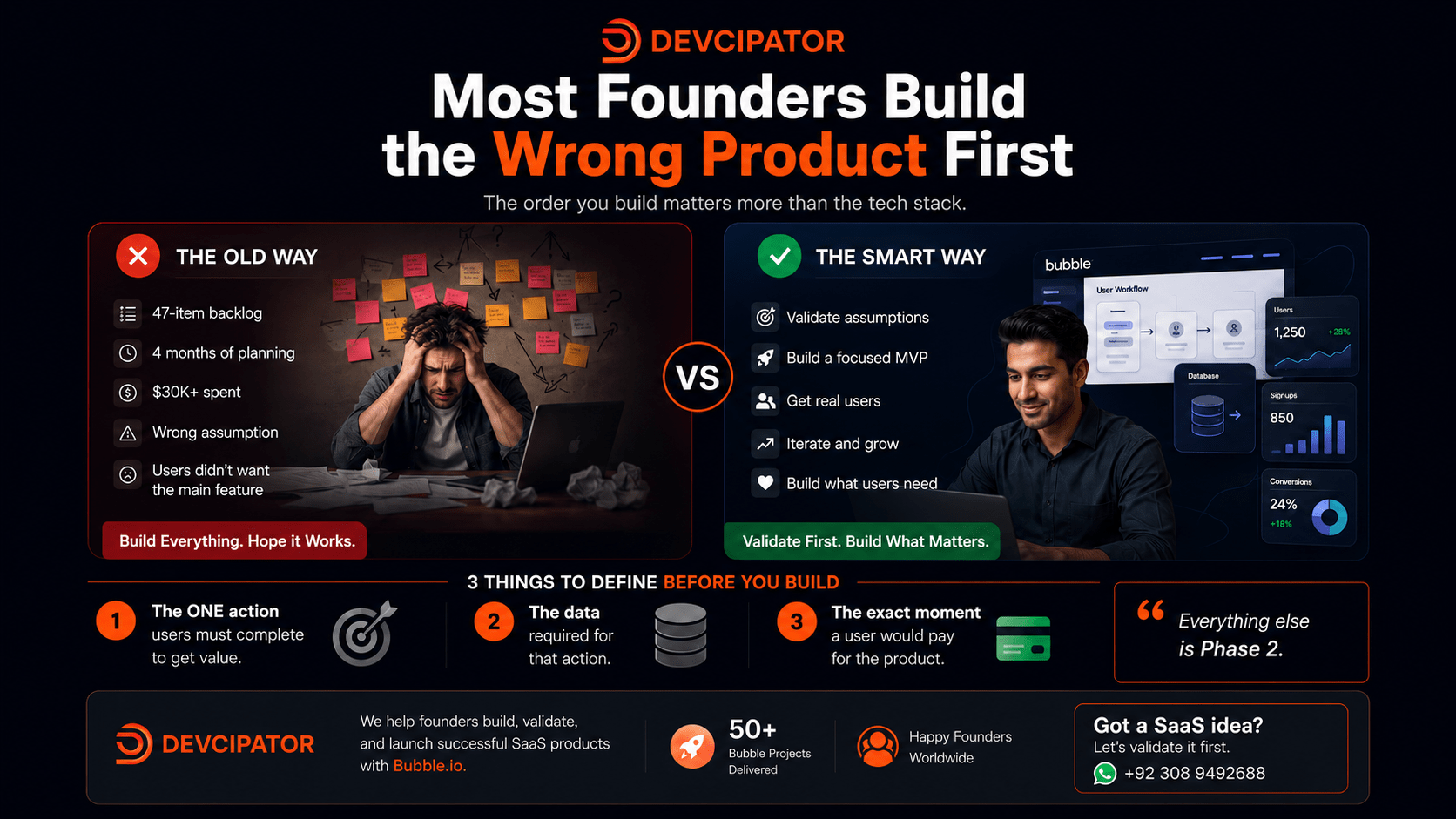
He had a SaaS idea he was genuinely excited about. He spent four months meticulously planning out every feature, every screen, every edge case. By the time he was done, he had:
- A 47-item feature backlog
- A hired development team burning through runway
- Over $30,000 spent – before a single user ever touched the product
Launch day came. The feedback rolled in.
The core assumption behind the entire product? Wrong.
The feature he had spent the most time building, the one the whole roadmap was structured around – was something users didn’t even want.
Four months. Thirty thousand dollars. One painful lesson.
The Order You Build In Matters More Than the Tech Stack
Most founders follow this process almost by instinct:
Idea → Design → Build → Test → Launch
It feels logical. It feels productive. It feels like progress.
But here’s what successful SaaS founders actually do:
Idea → Validate Assumptions → Build an MVP → Get Real Users → Iterate Fast
The difference isn’t talent. It isn’t funding. It isn’t even the idea itself.
It’s the sequence.
Validating before building means you’re solving a problem that actually exists, for users who actually care. Every step after that becomes faster, cheaper, and more focused.
Why Bubble.io Changes the Game
This is where Bubble.io enters the conversation, and not for the reason most people think.
Yes, Bubble is no-code. Yes, it’s fast. Yes, it’s powerful for building web apps without a traditional engineering team. But that’s not what makes it genuinely valuable for early-stage founders.
Bubble is powerful because it forces you to think clearly.
When you start building in Bubble, you’re immediately confronted with real product questions:
- User workflows : What does the user actually do inside this product?
- Database structure : What data does this product need to store and retrieve?
- Real user actions : What buttons get clicked? What forms get submitted? What triggers value?
- Product clarity : What exactly are we building, and why?
You can’t hide behind vague product thinking when you’re setting up Bubble workflows. The tool demands that you know what the user needs to do. And that constraint? It’s actually a gift.
That forced clarity is what prevents overbuilding.
The 3 Things We Define Before Writing a Single Line of Logic
At Devcipator, before we kick off any Bubble.io project – whether it’s a marketplace, a SaaS dashboard, or an internal tool – we define three things first:
1. The ONE Action Users Must Complete to Get Value
Not five actions. Not a full user journey. One. What is the single thing a user needs to do in this product that makes them say, “Okay, this is useful”?
2. The Data Required for That Action
What information does the product need to make that action possible? What does it need to store? What does it need to display? Strip it down to the minimum.
3. The Exact Moment a User Would Pay for the Product
This is the most important question of all. Not “what features would make someone pay eventually” – but when, in the user journey, does the product become worth money? That moment defines your MVP scope.
Everything else is Phase 2.
This framework alone has saved our clients months of wasted development and helped us ship products that users actually engage with from day one.
What 100+ Bubble.io Projects Taught Us
After shipping more than 100 projects on Bubble.io, we’ve noticed something that surprised us early on:
The fastest projects were never the simplest ones.
You’d think a simple product would be the easiest to ship quickly. But that’s not what the data showed. The projects that moved fastest were the ones where founders came in with deep clarity about their users – who they were, what they struggled with, and what a win looked like for them.
Bubble rewards that clarity. When you know exactly what you’re building and why, Bubble.io becomes one of the fastest, most reliable ways to get a real SaaS product in front of real users.
When you don’t have that clarity? The tool doesn’t matter. No tech stack – no-code or otherwise – will save a product built on guesswork.
The Right Tool Needs the Right Strategy
Here’s the honest truth about no-code tools, and Bubble specifically:
They lower the barrier to building. They don’t lower the barrier to building the right thing.
That still requires talking to users. It still requires challenging your assumptions. It still requires being willing to hear “I wouldn’t use this” before you’ve sunk six months into it.
But when you pair a validated idea with a clear MVP scope and build it in Bubble? You can go from concept to live product in weeks -not quarters. You can iterate based on real feedback without burning your entire runway. You can test pricing, test onboarding, test core features, and actually learn.
That’s the combination that works.
Ready to Validate Your SaaS Idea?
If you’re at the stage where you have an idea but you’re not sure what to build first, what to skip, or how to structure your MVP – that’s exactly where the right guidance makes all the difference.
We’ve helped founders across industries go from rough concept to funded, revenue-generating products using Bubble.io. Not by building everything – but by building the right things in the right order.